How to Become a Police Officer in Florida in 2027
If you want to know how to become a police officer in Florida, start with one fact — the route is set by a single state law — section 943.13, Florida Statutes — and run by FDLE, the Florida Department of Law Enforcement. No city invents its own rules — every city hires from the same certified pool, so how to become a police officer in Florida is the same five steps everywhere in the state. This guide covers the requirements, the 770-hour academy, the state exam and hiring — updated for the 2027 hiring cycle, when knowing how to become a police officer in Florida early matters, because academy classes fill on fixed schedules.
How to Become a Police Officer in Florida in 5 lines
Law: Section 943.13, Florida Statutes · Regulator: FDLE / CJSTC
Minimums: Age 19 · US citizen · High school diploma or GED · No felony conviction · Good moral character
Route: Minimums → 770-hour academy → SOCE → Agency hire → Certification
Pay: Median $74,470 a year (BLS, May 2025) · Bonuses up to $20,000 at some agencies
Time: About 6–9 months, academy included
What Are the Minimum Requirements? (Section 943.13)
Every item below is from section 943.13, verified by the employing agency — treat it as a hard gate:
- Age 19 or older for law enforcement, and a citizen of the United States.
- High school diploma or GED. No college degree is required by the state — some agencies ask for more.
- No felony conviction, and no misdemeanour involving perjury or a false statement (a guilty or no-contest plea counts the same).
- No dishonourable discharge from any branch of the US Armed Forces.
- Good moral character — a background investigation with drug testing, FDLE/FBI fingerprinting, a physical examination, and the Affidavit of Applicant form CJSTC-68.
What Are the 5 Steps to Become a Florida Police Officer?
FDLE publishes the route as five steps, in this order:
Step 1 — Meet the minimum qualifications in section 943.13, listed above.
Step 2 — Complete the training: the 770-hour Basic Recruit Training Program at a certified school (out-of-state officers: see EOT below).
Step 3 — Pass the State Officer Certification Examination (SOCE).
Step 4 — Get employed by a Florida agency. The agency hires you, runs your background investigation, and files form CJSTC-59 for you.
Step 5 — Pass the file review. Commission staff check your file against section 943.13; anything missing gives the agency 90 days to fix it.
An agency may hire you earlier under a Temporary Employment Authorization and send you to the academy itself — some recruits are paid in training; others self-sponsor.
What Happens at the Police Academy?
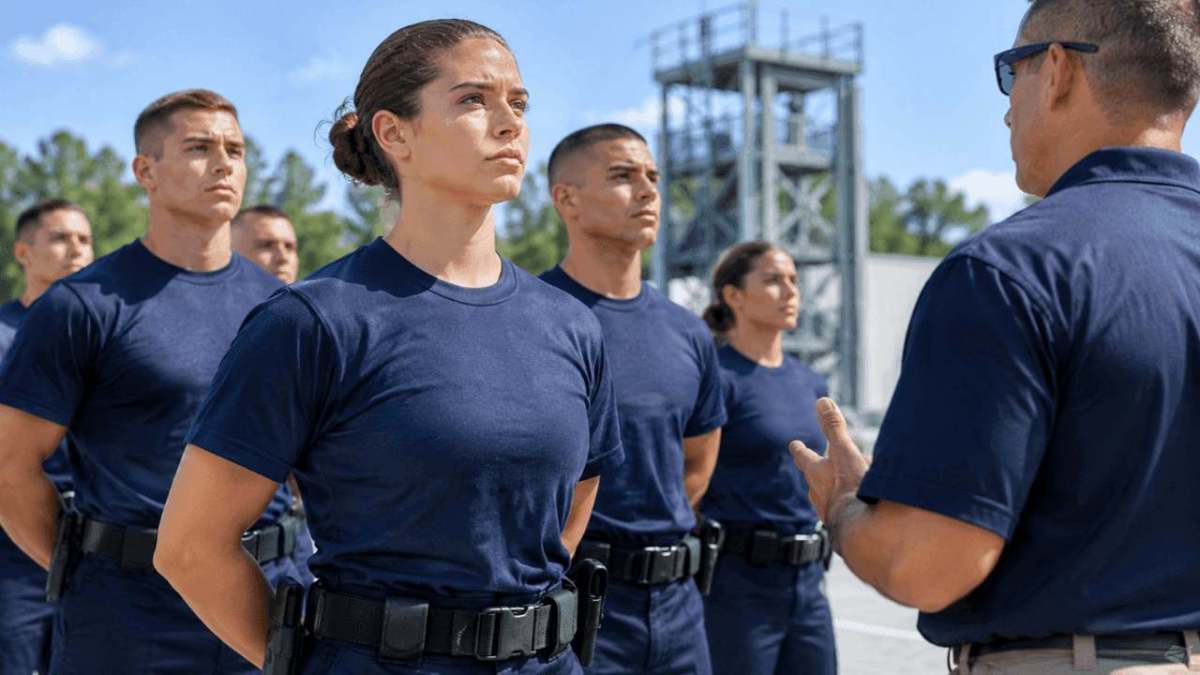
The Basic Recruit Training Program is 770 hours at certified training schools — in person only; FDLE offers no online route. Full-time classes run about five to six months; part-time night classes take about eleven months. Before it, most recruits pass the CJBAT entrance test (Pearson VUE); veterans and associate-degree holders are exempt by law. Pass each step once, and the whole route takes roughly six to nine months.
What Is the State Officer Certification Examination (SOCE)?
The SOCE is taken after the academy and built on the academy curriculum: 200 questions, 80% needed to pass, three attempts allowed. Fail all three and you must complete the full 770-hour academy again before retrying — so prepare during the academy, not after it.
Already an Officer in Another State? The Equivalency Route
Florida does not make experienced officers start from zero. Equivalency of Training (EOT) exempts you from the full academy if you served at least one year full-time within the past eight years as a sworn officer — another state, federal or military You complete a shorter equivalency process and the SOCE instead, within one year of the approved application, or the full academy applies.
How Much Do Florida Police Officers Earn?
Florida employs about 43,630 officers, with median pay of $74,470 a year (BLS, May 2025). One live example: Pembroke Pines starts officers at $71,885 with no experience and $82,668 for certified officers with 5+ years — and through December 31, 2026 it pays a $20,000 hiring bonus to certified officers and $15,000 to non-certified applicants. Full breakdown: Pembroke Pines Police hiring guide.
3 Mistakes That Delay Florida Certification
- Booking the CJBAT when you are exempt. Veterans and degree holders skip it by law — booking wastes money and weeks.
- Assuming certification comes before the job. It does not — the certificate comes only after an agency hires you and files form CJSTC-59.
- Treating the SOCE as a formality. Three failed attempts mean repeating the entire 770-hour academy.
Frequently Asked Questions
What is the minimum age to become a police officer in Florida?
The minimum age is nineteen, set by section 943.13, Florida Statutes. You must also be a US citizen, hold a high school diploma or GED, have no felony conviction, and pass a background investigation, drug testing, fingerprinting and a physical examination.
Do you need a college degree to be a police officer in Florida?
No — Florida law requires only a high school diploma or GED. Some agencies ask for more — Pembroke Pines, for example, wants an associate degree or a veteran/reserve or experience alternative — but the state minimum is the diploma.
How long is the police academy in Florida?
The Basic Recruit Training Program is 770 hours at a certified training school, in person only. Full-time classes take about five to six months; part-time night classes about eleven months. After graduation you must still pass the state certification exam, the SOCE.
Become a Police Officer in Florida 2027
You now know how to become a police officer in Florida: meet the 943.13 minimums, clear the CJBAT unless exempt, finish the academy, pass the SOCE, and get an agency to hire you. The route is fixed — how to become a police officer in Florida is the same in every county — but the offers at the end are not, and the best doors have deadlines. Start with the live one: our Pembroke Pines guide breaks down a $20,000 bonus ending December 31, 2026. Browse every opening on the USA Police Careers hub — and for the 2027 classes, start now, because how to become a police officer in Florida rewards candidates who begin before the class lists fill.